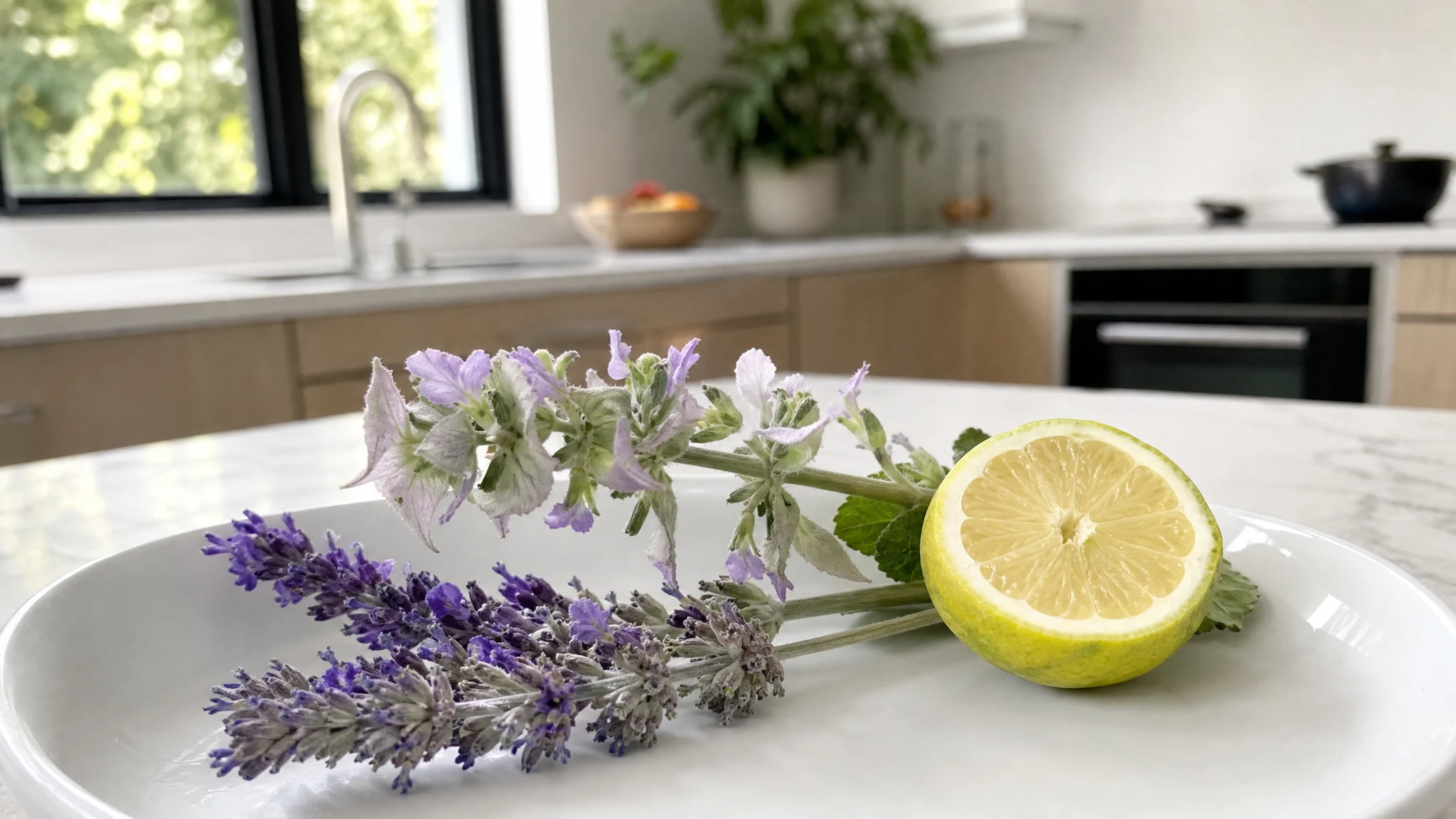
4:2:1 Lavender, Clary Sage and Bergamot: The Maths
Lavender, clary sage and bergamot make one of the loveliest three-oil blends on paper: floral, herbal and bright citrus. A 4:2:1 ratio, four parts lavender to two of clary sage and one of bergamot, is a popular way to put them together. The interesting part is not the ratio, it is the bergamot. At one part in seven, the smallest oil in the blend sets the ceiling for the whole bottle, and the arithmetic is worth doing before you pick a strength.
Lavender Essential Oil
Our own Lavender Essential Oil, in sizes from 0.5 oz to bulk.
From $12.99
Shop Now →The bergamot sets the ceiling
The Tisserand Institute, drawing on the IFRA guideline, says that bergamot oil should be limited to a maximum of 0.4 percent in the final product for leave-on products used on skin exposed to sunshine, with bath preparations, soaps and other wash-off products exempt (Tisserand Institute, Phototoxicity: essential oils, sun and safety). The cause is bergapten, a naturally occurring compound in bergamot oil that is behind its phototoxicity, meaning skin can react to ultraviolet light.
So here is the maths. With bergamot as one seventh of the blend, a 0.4 percent bergamot limit means the whole blend can be at most 0.4 x 7 = 2.8 percent of the finished product. The table below shows what each blend strength means for each oil. Treat it as approximate, since drops are not exact measures and the oils differ in thickness.
| Whole blend in carrier | Lavender | Clary sage | Bergamot |
|---|---|---|---|
| 0.5% | 0.29% | 0.14% | 0.07% |
| 1% | 0.57% | 0.29% | 0.14% |
| 2% | 1.14% | 0.57% | 0.29% |
| 3% | 1.71% | 0.86% | 0.43%, over the limit |
A 3 percent blend would fall inside the Tisserand Institute's 1 to 3 percent range for body oils, and still push the bergamot over its own limit on skin that will be in the sun. Bergamot oil that has had the bergapten removed is a different material: a 2015 review notes that a furocoumarin-free oil is prepared for perfumery and cosmetic uses because bergapten drives the phototoxicity (Navarra et al.). If you buy that kind, get the seller's documentation in writing, because a label alone does not show it. Our own rule of thumb is to keep the blend at 2 percent or below for anything left on skin.
Setting it against the other ranges
The same Tisserand page on dilution lists 0.2 to 1 percent where skin is sensitive or impaired, 0.5 to 1.2 percent for facial products and 1 to 3 percent for body oils and lotions. Our own dilution guidance for the lavender oils we sell is 0.5% to 2% in a carrier with a patch test first, and we start at the low end. That guidance is for lavender on its own. For a blend, it is the total that matters, so the sensible reading is that the whole blend should sit inside the strictest range that applies to the person and the place. For a face product, that is 1.2 percent at most, which would put lavender at about 0.69 percent and bergamot at 0.17. We do not give a safe maximum for any oil, and published limits for lavender and clary sage differ by material, so check them for the exact oils you buy.
A worked formulation
This is arithmetic, not a signature recipe. For a roughly 1 percent body oil: 8 drops lavender, 4 drops clary sage and 2 drops bergamot, which is 14 drops or about 0.7 ml at the rough count of 20 drops per ml, in 70 ml of a carrier oil such as sweet almond or fractionated coconut. Use a carrier with no water in it so no preservative is needed, and bear in mind nut and coconut allergies when you choose. Clary sage, bergamot and carrier oils come from a supplier that documents species and batch, since we sell only our four lavender-family oils. Our guide to lavender for massage covers carriers.
Why 70 ml? Because the ratio does not shrink well. A 30 ml bottle at 1 percent needs 0.3 ml of blend, which works out to about 3.4 drops of lavender, 1.7 of clary sage and 0.9 of bergamot. Drops cannot be split like that, and rounding the bergamot up to two drops nearly doubles its share. Either make a bigger batch, or measure with a graduated pipette or syringe.
Smelling the blend before you make it
Before you mix anything, open the three bottles one at a time and smell each from a few centimetres away. Then hold lavender and clary sage together, and finally add the bergamot. You may find the clary sage reads herbal and the bergamot bright and citrusy, with lavender in the middle linking them. Letting your nose set the order of importance is more reliable than any ratio, and it tells you early if one oil is going to shout over the others.
Write the numbers on the bottle as you go: how many drops of each, how much carrier and the date. A blend you love is easy to repeat if the label tells you exactly what you did, and a blend you do not love is easy to fix when you can see which part to change.
Three oils, one family of molecules
The blend sounds varied, but the oils share a good deal of their chemistry. A 2015 review reports bergamot oil with 2 to 20 percent linalool and 15 to 40 percent linalyl acetate (Navarra et al.), the same two molecules that make up much of true lavender, which is part of why lavender and bergamot sit so naturally together. Our chemistry post looks at them more closely. That overlap also means a reaction in a three-oil blend is hard to pin on one ingredient, so patch test first, see how patch tests work, and keep our dilution ratios to hand.
Think of 4:2:1 as a pleasant place to begin, then adjust by nose, one drop at a time, keeping an eye on that bergamot.
Lavender Essential Oil
Lavender Essential Oil from our own shop, in sizes from 0.5 oz to bulk.
From $12.99
Shop Now →