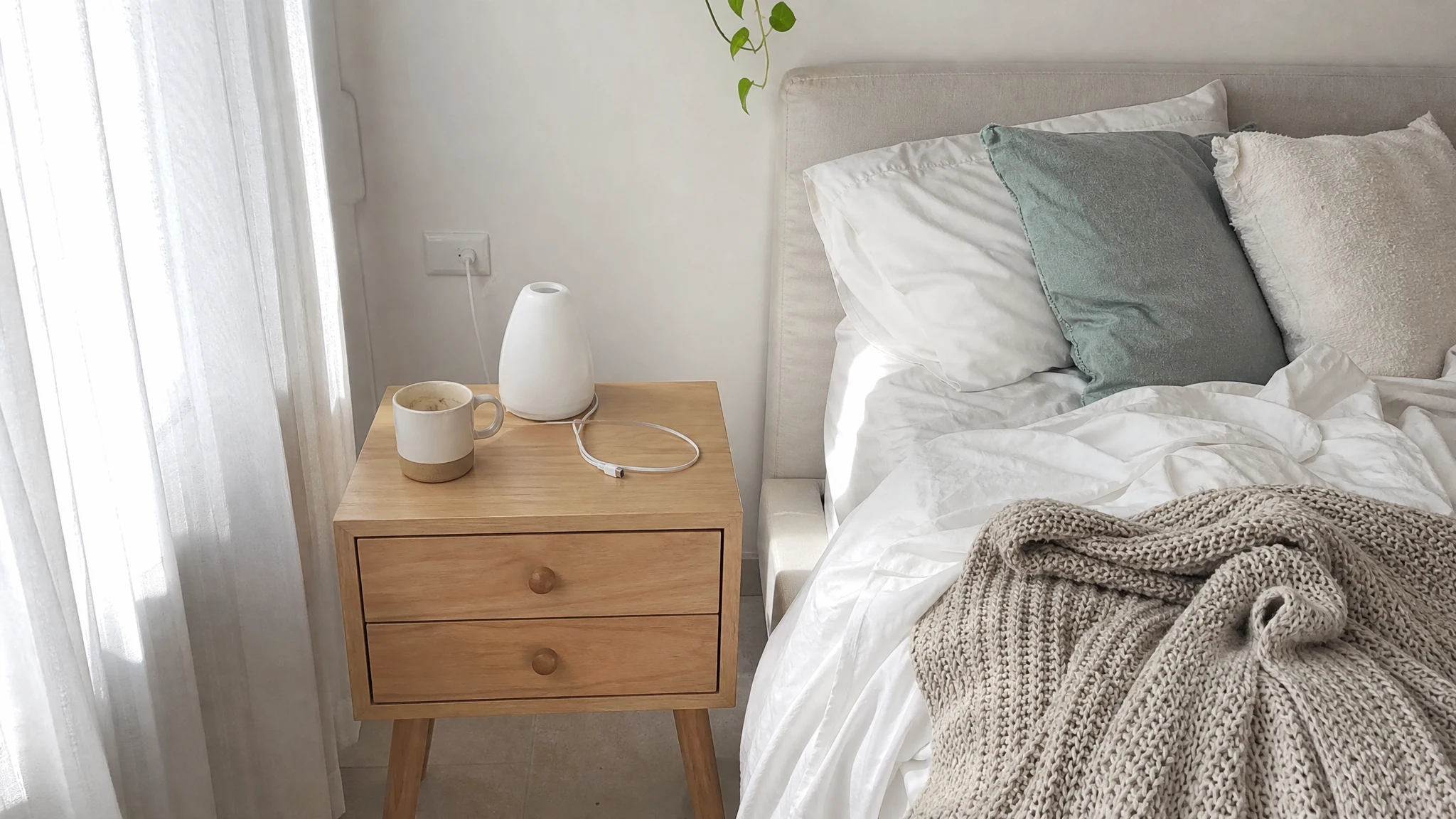
Diffusing Lavender Oil: How Long, How Much, Which Kind
A diffuser puffing out lavender is one of the easiest ways to make a room smell like somewhere you want to be. The habit is simple, but a few details make it better: how long it runs, what goes in the tank, and which lavender you pick for the job. Here is how we think about all three.
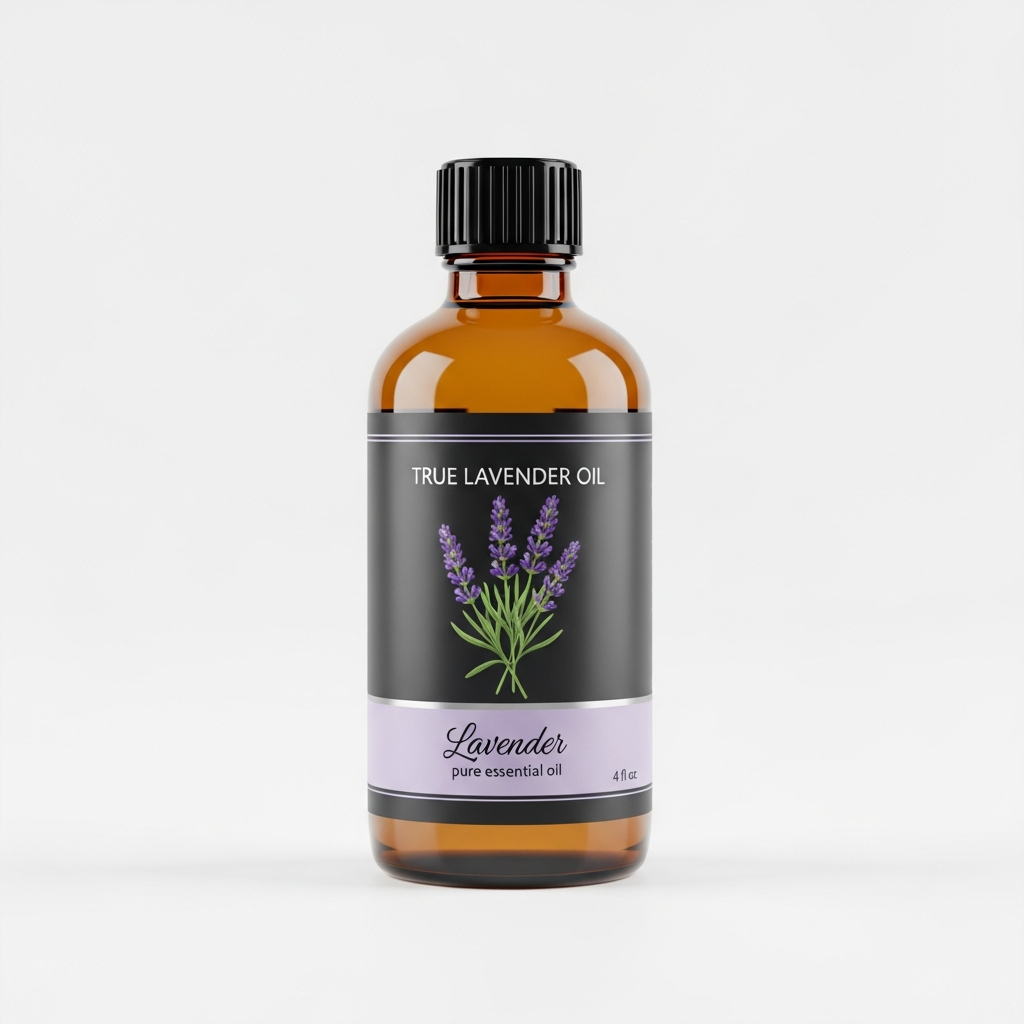
Lavender Essential Oil
Our own Lavender Essential Oil, in sizes from 0.5 oz to bulk.
From $12.99
Shop Now →What the studies did and did not look at
Lavender and sleep is the pairing everyone asks about, so it is worth knowing how the research actually looks. A trial of 79 college students had them wear a small patch holding Lavandula angustifolia oil on the chest at night for five nights, alongside sleep hygiene habits. Their sleep quality scores improved, though the group that practised sleep hygiene with a blank patch improved too, just less (Lillehei et al., 2015). That was a patch worn close to the nose, not a diffuser filling a bedroom.
A 2026 pooled analysis of 11 randomised trials with 628 adults reported a positive overall result for lavender oil and sleep, and its authors say more high-quality studies are needed before anyone leans on it (Shen et al., 2026). A study that did use diffusers let 112 healthy adults choose their own scent and delivery method; the diffuser users reported better sleep quality, while the wearable tracker found no difference between groups (Li et al., 2025). People who picked their own scent may simply have chosen something they liked.
Federal sources stay cautious. The National Center for Complementary and Integrative Health says it is unclear whether lavender aromatherapy helps with anxiety, stress or sleep, and that it may cause headache or coughing in some people. FDA treats claims to help you sleep as drug claims, so we do not make them. We sell lavender oils for their fragrance, and we think of a diffuser as a way to enjoy a scent.
Why we favour short sessions
Your nose gets used to a smell quickly. A review of human olfaction describes habituation to an odour as relatively fast, which means the first few minutes carry most of the pleasure. Our reasoning from that is simple: a diffuser running for a stretch around the time you settle in gives you the scent at its best, and running it for eight hours mostly adds output you have stopped noticing.
There is an air-quality angle too. A chamber study of an ultrasonic diffuser measured what came out when it ran with lemon, lavender, eucalyptus and grapeseed oils. Each oil produced its own particle profile, and the water mattered: with eucalyptus oil, tap water gave about five times the fine-particle output of deionised water. The authors conclude that ordinary use can add noticeably to indoor particles, depending on the oil and the water (Schwartz-Narbonne et al., 2021). It was one device in one chamber, so we read it as a gentle nudge toward habits that are easy anyway: a timer, an open door or window now and then, and whatever water the maker of your diffuser recommends.
How much oil goes in
Because every diffuser is built differently, the maker's instructions are the best guide to how much oil the tank needs, and starting at the low end is a good habit. The Tisserand Institute notes that drop counts are always approximate, since no two drops of essential oil are the same. If you notice a headache or a cough, switch it off and air the room.
A simple way to find your own level: start with the low amount, step out of the room for ten minutes, and walk back in. That return is the best test of whether the scent is right. If it greets you pleasantly, you have it. If it is the first thing you notice from the doorway, use less next time.
Which of our four oils for a bedroom
We sell four lavender-family oils, and they smell different enough that the choice matters more than any blend recipe. Our Lavandula angustifolia oil is soft, floral and gently herbaceous with a clean, sweet finish, which is the profile most people picture when they say lavender. Lavandin grosso has a fresh, herbaceous, floral character with a camphor-tinged lift. Spike lavender is sharper and more camphoraceous with a green edge and little sweetness. Our 40/42 is a trade grade described as smooth, sweet and floral-herbaceous; its exact species is not specified, so ask us through the contact page if that matters to you.
For a quiet evening scent, the angustifolia oil is where we would start. For a larger, airier room, lavandin grosso carries well. Neither is a better product than the other; they are different scents. We do not sell diffusers, carrier oils or other essential oils, so a blend with cedarwood or orange means a trip to a craft or supply shop. Our sleep guide goes deeper into the studies.
Little habits that make a diffuser nicer
Clean the tank when you change oils, following your maker's instructions, so one scent does not linger under the next. Use a timer if yours has one. Place the diffuser where the scent drifts across the room rather than right beside where you sit: a shelf across the room is often nicer than the bedside table. And when you come back into the room after a while, take one deliberate breath. That first breath is the one you wanted all along.
Homes with animals
Keep the bottle away from children and pets. Cats and dogs react very differently from people, so please read our posts on cats and dogs and talk to your veterinarian before diffusing around them. Keep each bottle tightly capped and out of heat and sunlight, as we describe in our storage guide.
A scent should feel like a treat, so diffuse for the length of time you enjoy it, then let the room breathe.
Lavender Essential Oil
Lavender Essential Oil from our own shop, in sizes from 0.5 oz to bulk.
From $12.99
Shop Now →Sources & Further Reading
- Lillehei AS et al. Effect of Inhaled Lavender and Sleep Hygiene on Self-Reported Sleep Issues: A Randomized Controlled Trial. J Altern Complement Med, 2015
- Shen H et al. The Sleep-Enhancing Effect of Lavender Essential Oil in Adults: A Systematic Review and Meta-Analysis. Holist Nurs Pract, 2026
- Li Z et al. Effects of nighttime odor exposure and delivery methods on subjective sleep quality in healthy adults. Sci Rep, 2025
- Pellegrino R et al. Habituation and adaptation to odors in humans. Physiol Behav, 2017
- Schwartz-Narbonne H et al. Volatile organic compound and particulate matter emissions from an ultrasonic essential oil diffuser. Indoor Air, 2021
- Lavender: Usefulness and Safety, NCCIH
- Aromatherapy, FDA
- Dilution for essential oils, Tisserand Institute