How to Dilute Lavender Oil: A Guide by Body Area
Ask five people how to dilute lavender oil and you will hear five ratios. The reason is that the right strength depends less on the oil than on where it is going: a face cream and a body lotion are not the same job. Start with the place on the body, and the number follows.
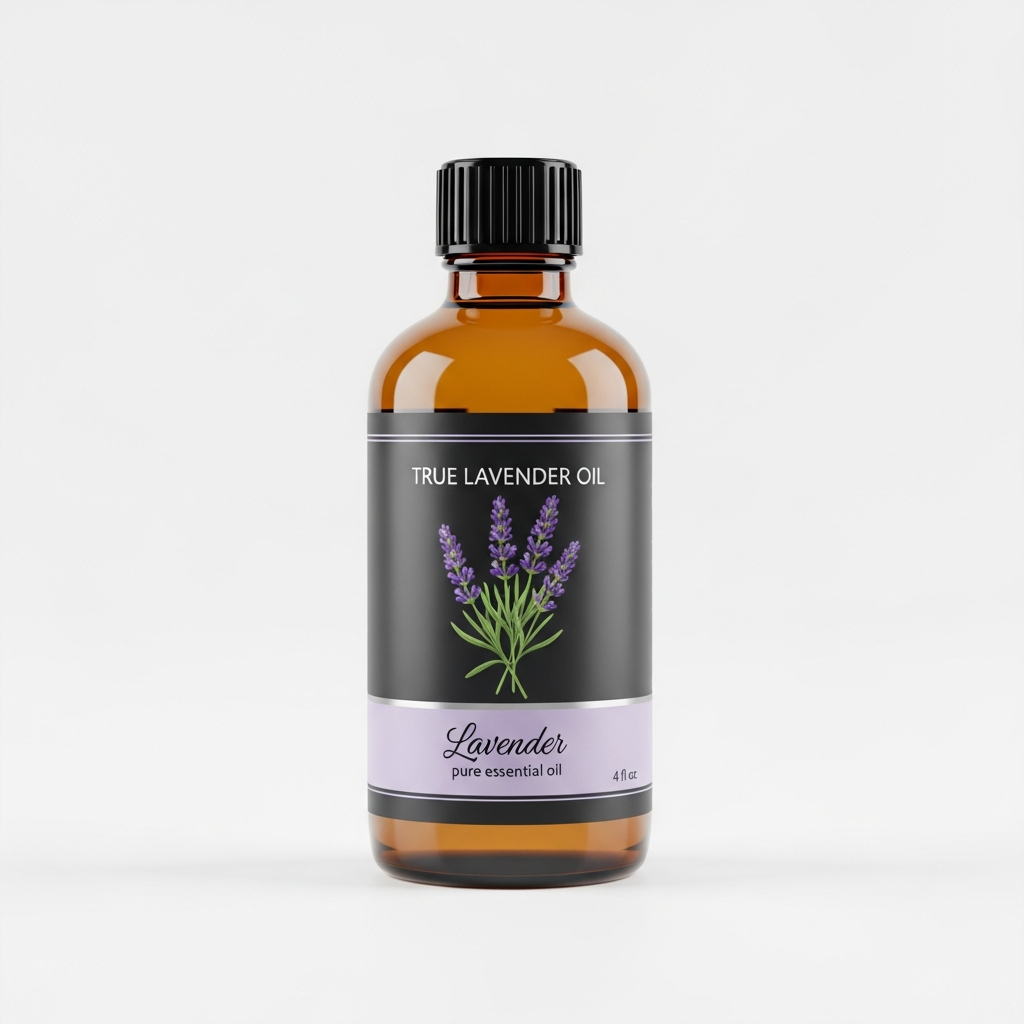
Lavender Essential Oil
Our own Lavender Essential Oil, in sizes from 0.5 oz to bulk.
From $12.99
Shop Now →Match the strength to the job
The Tisserand Institute sorts dilutions by use rather than by oil. Its ranges run from 0.2 to 1% for sensitivity issues and impaired skin, 0.5 to 1.2% for facial cosmetics and deodorants, 1 to 3% for body oils and lotions, and 2 to 4% for bath products. Our own guidance for all four of our lavender-family oils, true lavender, lavandin grosso, spike lavender and 40/42, is 0.5% to 2% in a carrier, with a patch test first.
Those two lines overlap, but the top of ours sits above the top of the facial range. So we start at the lower figures: about 0.5% to 1% for a face product and 1% for a body oil, moving up only if you want a stronger scent and your skin is happy. We have found no source that lets us call 2% the right number for everyone, and we would rather you start low than discover your limit the hard way. If you want a worked example for the face, see our face oil formulation.
Turning a percentage into drops
Percentages mean volume or weight, and a dropper is neither. About 20 drops per millilitre is a rough convention, and Tisserand notes that conversions using drops are always approximate because no two drops of essential oil are the same. With that caveat, here is the arithmetic for a 30 ml bottle of carrier (about an ounce):
| Strength | Oil in 30 ml | Drops, roughly |
|---|---|---|
| 0.5% | 0.15 ml | 3 |
| 1% | 0.3 ml | 6 |
| 2% | 0.6 ml | 12 |
That matches our own line of about 3 to 12 drops per ounce of carrier. For anything you plan to repeat, a small syringe or a scale is more reliable. The one batch of our angustifolia oil on our published certificate has a relative density of 0.894, so 1 g is about 1.12 ml; we do not publish a density for our other three oils.
A small kit for mixing
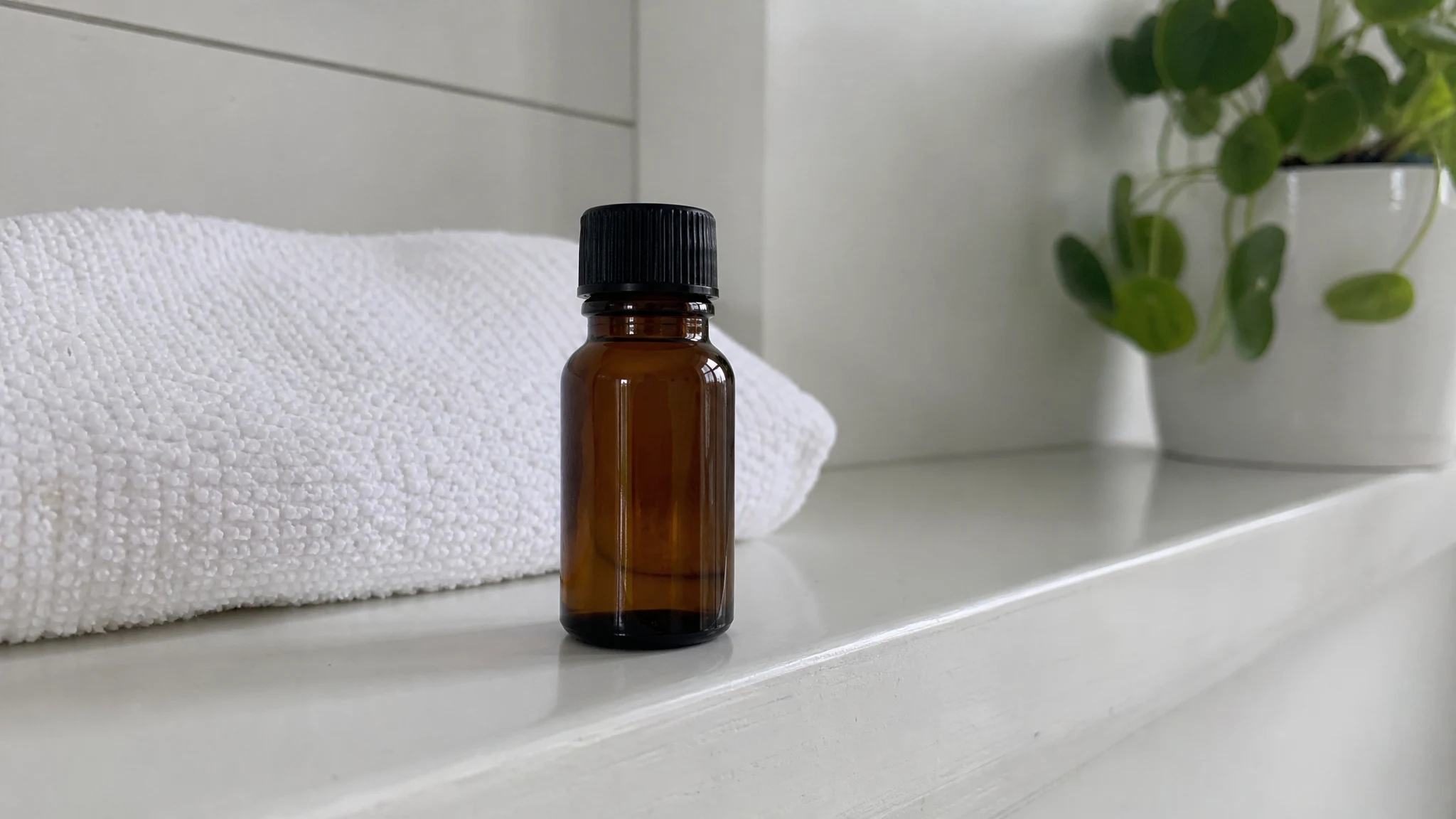
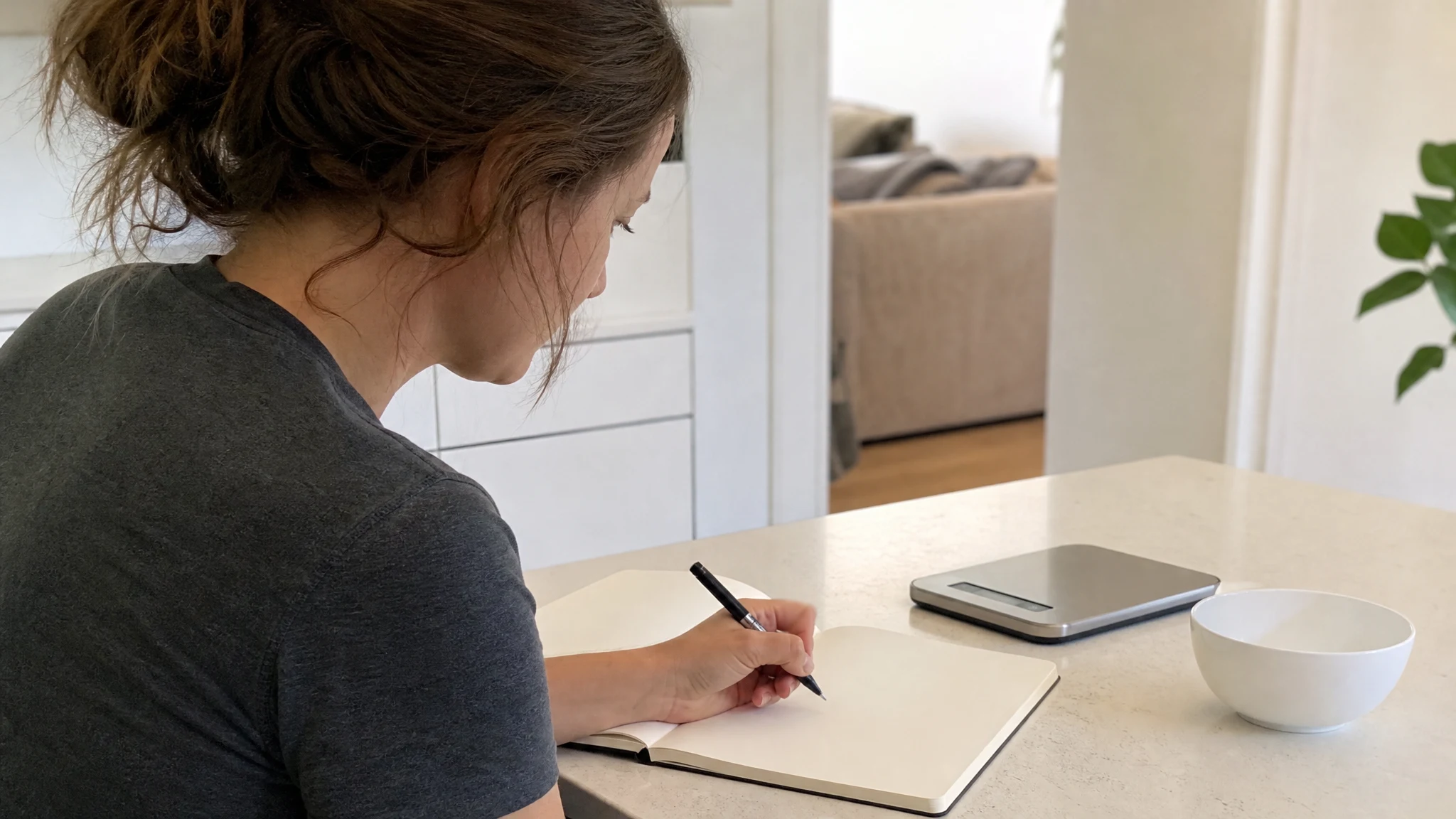
You do not need much: a clean glass bottle, a small funnel, a marker and a notebook. Measure the carrier first, add the lavender last, cap the bottle and turn it slowly to mix instead of shaking it hard. Then smell it. If the scent is stronger than you expected, the answer is more carrier, not less oil. Write the strength and the date on the bottle straight away, while you still remember exactly what you did.
A patch test is a start, not a verdict
We recommend a patch test, and it is worth knowing its limits. Tisserand says patch testing is not 100% reliable, with false positives and false negatives possible, and for anyone worried about reactions suggests starting with a low dilution, perhaps 1%, and rising in 0.5% steps. Lavender has a particular reason for care: a 2008 study found that lavender oil oxidises in air at the same rate as its main terpenes, that its sensitising potency rose as a result, and that people allergic to oxidised linalool reacted to air-exposed oil. A test on day one with fresh oil says little about the same bottle months later, which is why our guide to storing lavender oil belongs next to this one. Our allergy page explains how to run the test.
Make small batches
A 30 ml bottle goes a long way, and a small batch means the carrier and the oil are both still fresh when you reach the bottom of it. Keep it capped in a cool, dark cabinet, away from a sunny windowsill or a steamy bathroom shelf. If the blend ever smells different from the day you made it, that is a good reason to mix a new one rather than stretch the old one.
Who should check first
The National Center for Complementary and Integrative Health says topical lavender products may cause allergic skin reactions in some people, that a few cases of breast tissue swelling were reported in children using them (it is unclear whether lavender was responsible), and that little is known about use in pregnancy or breastfeeding. So for babies, children, pregnancy, nursing or a medical skin condition, take the question to a pediatrician, midwife, physician or dermatologist rather than to a dilution chart. Poison Control adds that essential oils should not be used on damaged skin and must be locked away from children and pets.
It also helps to keep a simple record. A line in a notebook with the date, the carrier, the strength and what you made it for turns your next batch into an easy decision. If you liked the scent and your skin was comfortable, you have the numbers to repeat it. If not, you know exactly what to change.
The carrier is your choice
We sell lavender oils, not carriers, so you will pick one at a craft shop, pharmacy or grocery. The maths does not change with the carrier. Buy a small bottle you will finish while it is fresh, because carriers are plant oils that can also go off, and if anyone using the blend has a tree-nut allergy, skip a nut-derived carrier such as sweet almond. Our carrier oil comparison walks through the options. Label the bottle with the strength and the date; an unlabelled bottle of diluted oil is easy to mistake for something else.
Our oils are sold neat, so every number here is yours to measure. Start low, write it on the bottle, and move up slowly.
Lavender Essential Oil
Lavender Essential Oil from our own shop, in sizes from 0.5 oz to bulk.
From $12.99
Shop Now →Sources & Further Reading
- Tisserand Institute. Dilution for essential oils.
- Tisserand Institute. Irritation and allergic reactions - Tisserand Institute.
- Hagvall L et al., 2008. Lavender oil lacks natural protection against autoxidation, forming strong contact allergens on air exposure. Contact Dermatitis.
- National Center for Complementary and Integrative Health. Lavender.
- Poison Control. Essential oils: Poisonous when misused.