Lavender Oil vs Synthetic Fragrance: What Is Different
"Natural versus chemical" is the wrong way to compare lavender oil with a synthetic lavender fragrance, because the two big molecules in lavender oil are ones a laboratory can make too. The real difference is how much you are told. A distilled oil comes with a plant, a Latin name and a published range you can check, while a fragrance on a label can be a single word.
Lavender Essential Oil
Our own Lavender Essential Oil, in sizes from 0.5 oz to bulk.
From $12.99
Shop Now →What is in a bottle of lavender oil
A 2023 review reports that commercial Lavandula angustifolia oil has linalool and linalyl acetate each above 20%, and tabulates the ISO 3515 and European Pharmacopoeia limits: linalool 20% to 45% and linalyl acetate 25% to 47%. A perfumer can buy both molecules made synthetically, so a synthetic lavender accord can contain them, usually with other aroma chemicals added to round out the smell. Your nose alone will not settle which is which, and a bare linalool figure will not either. Our chemistry post covers what each molecule contributes, and our glossary decodes report terms.
The mirror-image trick
Here is the neat part. Linalool and linalyl acetate each come in two mirror-image forms, written (R) and (S). A 2021 study built reference profiles from 20 genuine lavender oils and found the (R) forms dominate: 93.8% of the linalool and 99.4% of the linalyl acetate. Synthetic versions are racemic, meaning roughly equal parts of both forms. When the researchers spiked a lavender oil with 27% each of the synthetic pair, the (S)-linalool rose from 6.2% to 33.6% and the (S)-linalyl acetate from 0.6% to 19.6%, well outside the reference range.
In plain terms, a chemist can tell a plant-made molecule from a lab-made one by its handedness. That is a specialised analysis, though. The Certificate of Analysis we publish covers one batch of our angustifolia oil and gives density and refractive index, which is a different job. If you need chiral or GC-MS data for a lot, ask us in writing through the contact page and get the answer in writing; our GC-MS guide shows how to read what comes back.
Smelling the difference yourself
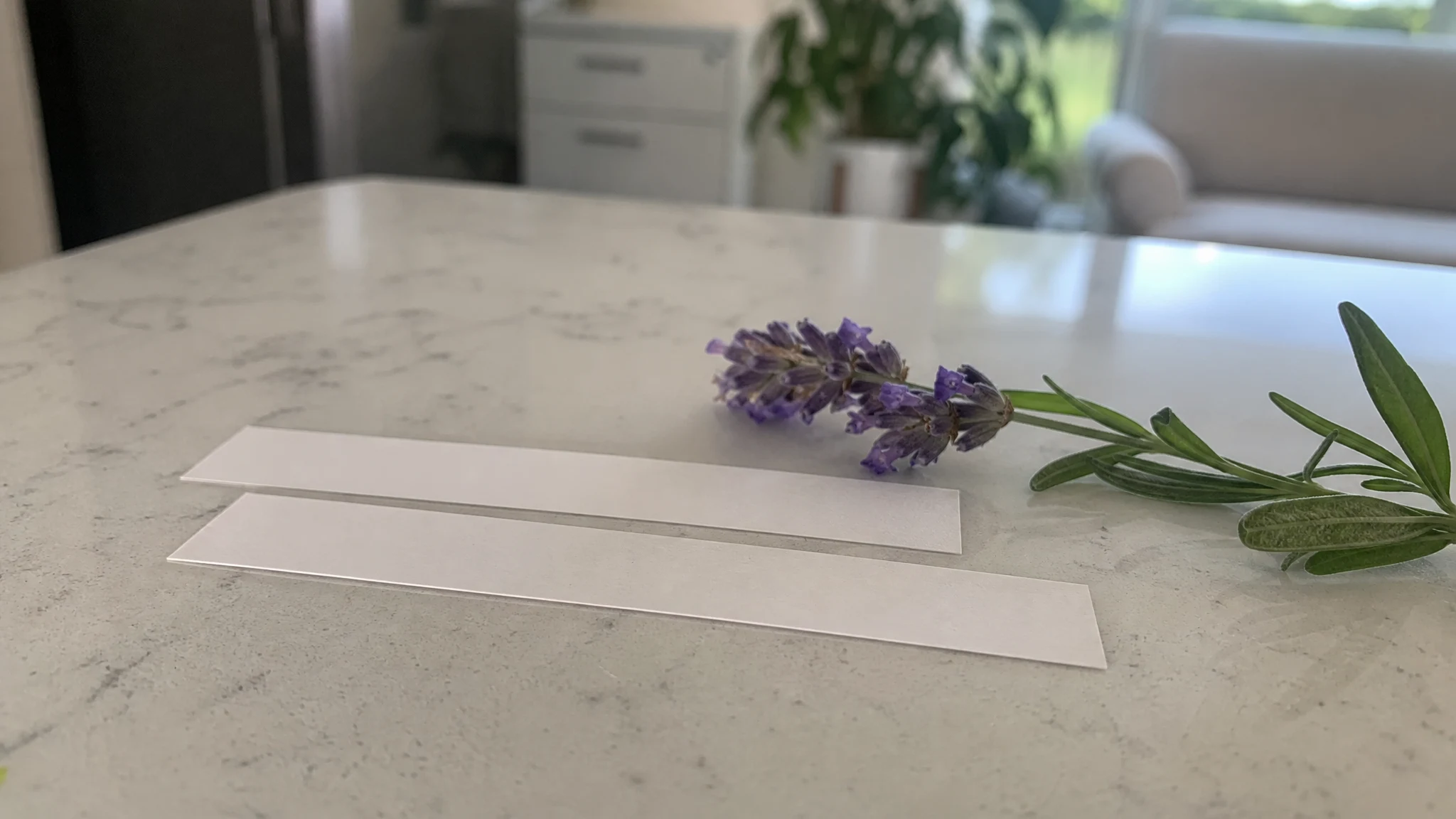
You do not need a laboratory to start noticing things. If you have a lavender-scented candle, a bottle of scented spray or a bar of soap in the house, hold it beside a bottle of lavender oil and take turns sniffing each one. A few things to pay attention to: does the scent stay exactly the same from first sniff to last, or does it seem to move a little as it meets the air? Does it feel flat and even, or does it have small edges, a green note here and a sweet note there? Your nose will not name the molecules, but it will tell you which one feels more like a plant.
Do not worry if you cannot tell them apart. Plenty of perfumers cannot do it reliably either, and that is the point made above. What your nose can tell you is which scent you actually enjoy, and that is a perfectly good way to choose.
What a label tells you
In the United States, FDA says fragrance and flavour ingredients can be listed simply as "Fragrance" or "Flavor", because the law cannot be used to force companies to reveal trade secrets. It also says FDA does not have the same legal authority to require allergen labelling for cosmetics that it has for food, and that there is no regulatory definition of "essential oils". So a product that says "fragrance" could contain a distilled oil, a synthetic accord or a mix, and the word "essential oil" on a label is not a guarantee either. The FDA suggests that people sensitive to fragrance look for fragrance-free products, read ingredient lists or ask the manufacturer.
That is why we like the Latin name. Our four lavender-family oils are Lavandula angustifolia, lavandin grosso (Lavandula hybrida), spike lavender (Lavandula latifolia) and a trade-grade 40/42 whose species our page does not state. We sell them neat, with no additives or fillers, and we do not sell fragrance oils.
Choosing for your project
A fragrance has a place in a lot of products, and a distilled oil has its own. If you are making something for yourself, such as a linen spray, a bar of soap or a diffuser blend, the plant-made oil gives you a name you can look up and a scent that varies with the oil you pick. We sell four lavender-family oils, so the first question is which aroma you want: the soft one, the fresh one, the sharp one or the smooth trade-grade one. Open them side by side before you decide, and let the nose pick your project.
Natural does not mean harmless on skin
This is the less comfortable half of the story, and worth knowing whichever you choose. Linalool oxidises in air, and in a patch-test study across six countries, 6.9% of 2,900 dermatitis patients reacted to oxidised linalool. Lavender oil lacks natural protection against oxidation, and air-exposed oil became more sensitising in a laboratory study. Neither finding says lavender oil is a bad choice; it says freshness matters, and that it is the same linalool molecule whether a plant or a laboratory made it. We keep bottles tightly capped, cool and dark, as in our storage guide, and we recommend dilution and a patch test before skin use.
For your own project, the practical choice comes down to what you want from the scent: a real plant with a name and a range you can check, or a formula you may never see. We love the first, and we are glad to help you pick which of our oils fits.
Lavender Essential Oil
Lavender Essential Oil from our own shop, in sizes from 0.5 oz to bulk.
From $12.99
Shop Now →Sources & Further Reading
- Crisan I et al. Current Trends for Lavender (Lavandula angustifolia Mill.) Crops and Products with Emphasis on Essential Oil Quality. Plants, 2023
- Capetti F et al. Adulteration of Essential Oils: A Multitask Issue for Quality Control. Three Case Studies: Lavandula angustifolia Mill., Citrus limon (L.) Osbeck and Melaleuca alternifolia (Maiden & Betche) Cheel. Molecules, 2021
- Fragrances in Cosmetics, FDA
- Bråred Christensson J et al. Air-oxidized linalool: a frequent cause of fragrance contact allergy. Contact Dermatitis, 2012
- Hagvall L et al. Lavender oil lacks natural protection against autoxidation, forming strong contact allergens on air exposure. Contact Dermatitis, 2008