Blending Lavender Oil: Ratios First, Then Dilution
Ask ten people how strong a lavender blend should be and you will hear ten answers, because they are answering two different questions. One is how much of each oil goes in relative to the others. The other is how much oil in total goes into the carrier. Keep those apart on paper and blending gets simple.
Lavender Essential Oil
Our own Lavender Essential Oil, in sizes from 0.5 oz to bulk.
From $12.99
Shop Now →Step one: set the ratio between oils
Write the blend as parts. Our 4:2:1 lavender, clary sage and bergamot post works one example through, and our pairings guide suggests partners. The rule for sizing the parts is that strong oils get small numbers. If you are unsure how forceful a partner is, start it at one part against three or four of lavender and adjust by smell, not by guessing.
Step two: set the total strength
This is the dilution, and it is a percentage of the whole carrier. Tisserand Institute lists three ranges: 0.5 to 1.2 percent for a facial product, 1 to 3 percent for the body, and 0.2 to 1 percent where skin is reactive or impaired. We recommend 0.5 to 2 percent in a carrier, with a patch test first. We start lower than the top of those ranges, at 0.5 to 1 percent, and keep to 0.5 percent for the face, because air-oxidised lavender constituents are a documented fragrance allergen and, as far as we can reason, a little more strength adds little to the scent. Treat every figure here as a starting point, and Tisserand notes that no two drops of essential oil are the same size.
The arithmetic, with a worked example
A drop is roughly 0.05 ml, so about 20 drops make 1 ml, though droppers vary. Say you want 30 ml of body oil at 1 percent:
- 30 ml of carrier x 0.01 = 0.3 ml of essential oil in total.
- 0.3 ml x 20 drops per ml = 6 drops.
- Split the six drops by your ratio: for 3 lavender : 2 cedarwood : 1 bergamot, that is 3, 2 and 1 drops.
For 60 ml at the same strength, double every number. For 0.5 percent in 30 ml, halve them: 3 drops in all. If the ratio will not split into whole drops, change the batch size, not the ratio. A 3:2:1 blend does not fit 7 drops; it fits 6 or 12.
The stock-blend shortcut
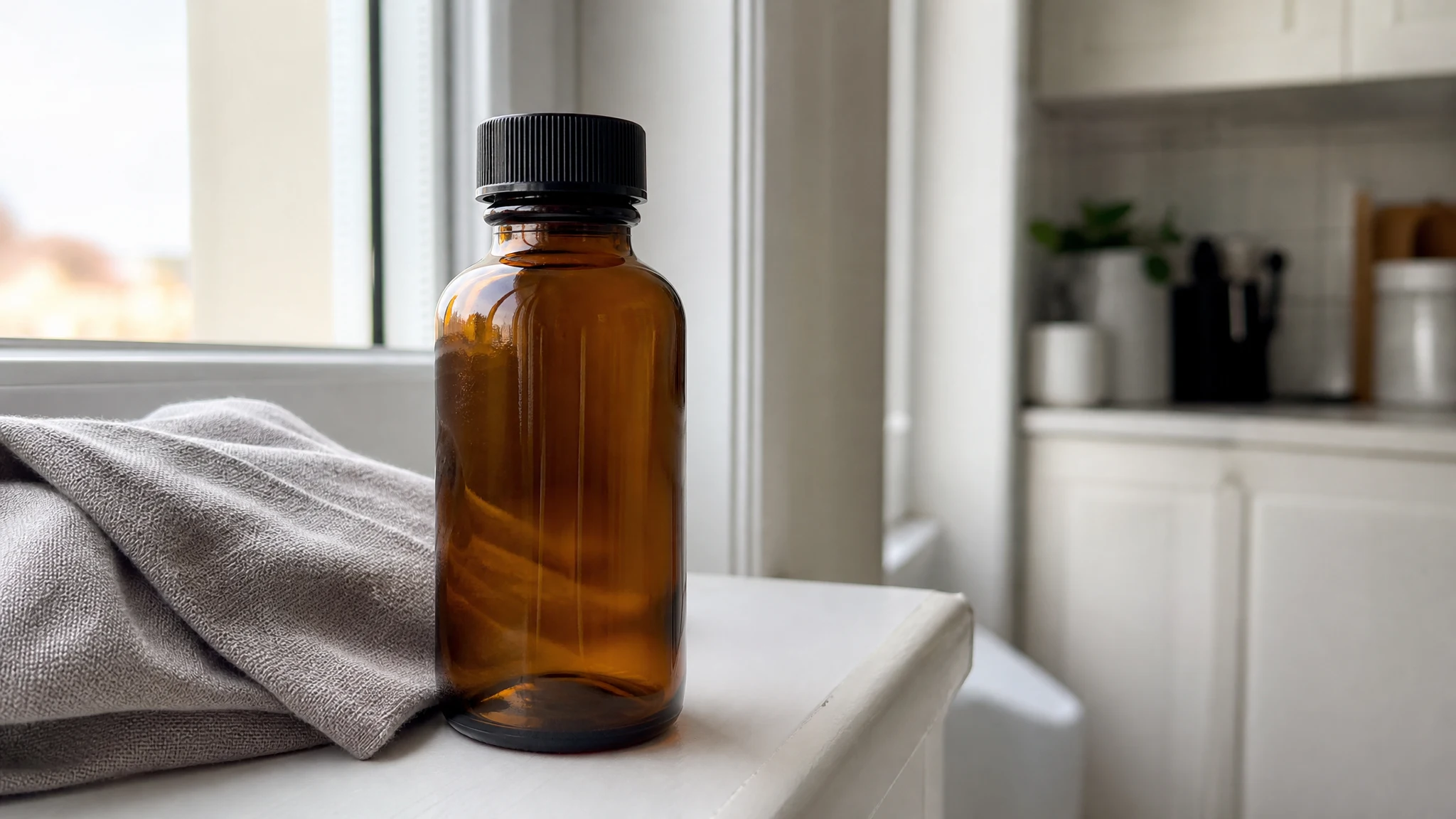
If you will make several products, mix the oils neat in a small glass vial at your ratio, for example 30 drops of lavender, 20 of cedarwood and 10 of bergamot. Then treat the vial like a single oil: 6 drops of stock into 30 ml of carrier for 1 percent. It saves counting and keeps batches consistent. Label the vial with the date, and remember that essential oils age, which is why it pays to mix small amounts.
Common mistakes
- Treating the ratio as the dilution. A 3:2:1 blend says nothing about strength.
- Forgetting the other oils count. The 1 percent is the total of all oils, not 1 percent of each. Six drops in 30 ml is the sum.
- Adding bergamot without checking. Tisserand's phototoxicity page gives a cap of 0.4 percent for bergamot in a leave-on product on sun-exposed skin; a bergapten-free bergamot is treated differently, so read the label from your supplier.
- Changing two things at once. Move one number, then smell and rewrite the ratio.
- Skipping the patch test. See our patch test routine.
Which lavender to use
We sell four lavender-family oils, sold neat, so the maths above is yours to do. Their strength on the nose differs: lavandin grosso has a camphor-tinged lift and spike lavender is sharp, so in a blend they can take a smaller share than the softer angustifolia or the 40/42. Published limits and literature differ by species, which is one more reason to start low. Our dilution by body area and carrier oil guides finish the job. Carriers and partner oils come from a craft or supply shop.
Write the two numbers at the top of the page, ratio on the left and strength on the right, and most blends fall out in a couple of lines.
Lavender Essential Oil
Lavender Essential Oil from our own shop, in sizes from 0.5 oz to bulk.
From $12.99
Shop Now →Sources & Further Reading
- Dilution for essential oils. Tisserand Institute.
- Phototoxicity: essential oils, sun and safety. Tisserand Institute.